Alliance Pushes Back on the Proposed Cuts to the Medicare Physician Fee Schedule
Specialty Docs Come to Capitol Hill!
Rheumatologists Call for Broader Drug Affordability Solutions for Patients in Response to Wyden RFI
Alliance Voices Strong Concerns Over OMB Federal Financial Assistance Financial Rule
ALLIANCE PUSHES BACK ON PROPOSED PHYSICIAN CUTS TO THE MEDICARE PHYSICIAN FEE SCHEDULE
The Alliance of Specialty Medicine submitted comments on the CY 2027 Medicare Physician Fee Schedule (PFS) proposed rule, opposing policies that further destabilize specialty physician practices and threaten patient access.
The Alliance expressed deep concern about ongoing reductions in Medicare payments to physicians, particularly as practice costs and inflation continue to rise. They  argued that CMS’s approach of establishing new coding and payment for primary care, care management, and preventive services – and now “lifestyle” medicine – while reducing payments for specialty care to maintain budget neutrality, threatens the financial stability of specialty practices and could ultimately limit patient access to necessary specialty care. The Alliance urged CMS to avoid further redistributive cuts and instead prioritize policies that strengthen the Physician Fee Schedule for all physicians until broader payment reform is enacted by Congress.
The Alliance also opposed several proposed policies, including significant changes to the indirect practice expense methodology and a proposed payment reduction when evaluation and management (E/M) services are billed with modifier-25 on the same day as a “global” procedure. They argue that these proposals lack sufficient data and transparency and could disproportionately harm specialty practices. Similarly, the Alliance criticized proposals to establish payment for new services like Shared Medical Appointments and Health Coaching without adequate evidence of their benefit or safeguards against fraud and overutilization.
Additionally, the Alliance called for improvements to the Quality Payment Program (QPP), advocating for voluntary rather than mandatory reporting pathways, more meaningful specialty-specific quality measures, and a balanced transition to digital quality measurement. They also support extending telehealth flexibilities and urge CMS to provide clear guidance on new telehealth requirements.
Throughout their comments, the Alliance emphasized the need for data-driven, transparent policy changes that do not shift resources away from specialty care, and called for collaboration with specialty societies to ensure that new payment and reporting requirements do not create undue administrative burdens or threaten the viability of independent specialty practices. The complete comment letter is available on the Alliance’s website.
Protecting Same-Day Care: Otolaryngology’s Campaign Against the Proposed Modifier 25 Cut
 By Harry DeCabo, Senior Director of Legislative and Political Advocacy, American Academy of Otolaryngology–Head and Neck Surgery
A 50 Percent Cut to Same-Day Care
On July 14, 2026, the Centers for Medicare & Medicaid Services (CMS) published the Calendar Year (CY) 2027 Medicare Physician Fee Schedule (MPFS) proposed rule. Among its payment provisions is a policy that would reduce payment for same-day care across nearly every specialty with office-based physicians, including many represented in the Alliance.
Beginning January 1, 2027, Medicare would reduce payment when a physician—or another physician in the same group practice—bills a separately identifiable office or outpatient evaluation and management (E/M) service with Modifier 25 on the same day as a procedure with a 0-, 10-, or 90-day global period. Medicare would pay 100% of the fee schedule amount for the highest-value service and reduce payment by 50% for each additional service. The reduction would apply even when the other services are medically necessary and clinically distinct. For some services, payment would fall below the direct cost of the clinical staff, supplies, and equipment required to furnish the procedure.
CMS states that it continues to “believe” the current payment methodology is “likely duplicating payment” when these services are furnished together. However, the agency has provided no evidence to support this claim. Existing code valuation processes already identify and remove overlapping work and practice expense for services commonly furnished together, so an additional across-the-board reduction would discount the same efficiencies twice. In fact, CMS asks for comment on whether a different figure, such as 25 percent, would more accurately reflect any overlap. This is the clearest signal in the rule itself that the policy is arbitrary and not evidence-based.
CMS considered and declined to finalize a substantially similar policy in CY 2019. The current version is broader, extending to procedures with 10- and 90-day global periods. Importantly, the agency has not shown that the concerns from its 2019 proposal have been resolved.
Why Otolaryngology Is Particularly Impacted
CMS’s own impact analysis estimates that the proposed changes would reduce otolaryngology’s overall Medicare payments by 9 percent, including a 10 percent reduction in the non-facility setting. That is before the proposed conversion factor cut of 1.68 percent takes effect. CMS projects the largest reductions from this policy for dermatology, otolaryngology, and podiatry.
Otolaryngology is among the hardest hit because so much of our diagnostic work happens at the point of care. Consider a woman in her 70s with a history of tobacco use who is referred for a neck mass and hoarseness. The physician first performs a comprehensive evaluation to determine the patient’s needs and cancer risk. That evaluation leads to the decision to perform a flexible laryngoscopy and a same-day biopsy.
The evaluation is clinically distinct from the laryngoscopy because the clinical judgment to perform a procedure is separate from the procedure itself. Paying half for that evaluation does not remove duplication. It penalizes the decision to complete the diagnosis in one visit.
Hearing Directly from Our Members
Two weeks after the proposed rule was released, AAO-HNS surveyed our membership to determine the effects this policy would have on them and their patients. The survey received over 1,400 responses.
Eight in 10 respondents said the proposal could reduce seniors’ access to care. Nearly 67 percent said they would have to see fewer Medicare patients, and 14 percent said they would have to stop accepting Medicare entirely. More than 84 percent said the policy could mean longer appointment wait times, fewer referral options, and greater difficulty obtaining timely specialty consultation.
Practice operations would change as well. Half of respondents said they would spend more time on documentation and administrative work. Nearly 30 percent said they would need to lay off staff.
The Same Day Care Coalition
An issue that reaches this many specialties needs more than one organization’s voice. Reaching out across organized medicine, AAO-HNS began recruiting national  physician and patient organizations in August to make a single, unified ask of CMS.
The Same Day Care Coalition now includes over 25 organizations, including several Alliance member organizations as well as primary care physicians, other medical specialists, surgical specialists, and the patients they serve. Patient organizations have joined alongside physician groups. This matters because the strongest argument against this policy focuses on patient access, not on reimbursement. The Coalition has published a joint one-pager for use with CMS and on Capitol Hill with a unified request that the agency not finalize the policy.
Engaging Congress
Over the past two months, AAO-HNS and coalition partners have briefed members of Congress and their health staff about this proposal. Physician members of Congress in both parties have been central to that effort, including the GOP Doctors Caucus and the Democratic Doctors Caucus.
That engagement produced a bipartisan sign-on letter to CMS Administrator Mehmet Oz, MD, urging the agency not to finalize the proposal. The letter was led by Reps. Greg Murphy, MD (R-NC), John Joyce, MD (R-PA), Kim Schrier, MD (D-WA), and Herb Conaway Jr., MD (D-NJ), and was signed by 74 members of Congress.
The letter carries an appendix of clinical use cases contributed by family medicine, ophthalmology, otolaryngology, dermatology, rheumatology, orthopaedics, and podiatry. These examples prove that this policy will negatively impact more than just a few specialties.
Next Steps
The Academy will hold a Hill Day dedicated to this issue on September 30, bringing otolaryngologists to Washington to meet with their own congressional delegations and to reinforce the Coalition’s ask before the final rule is issued.
We will keep vigorously advocating against this proposal until the rule is finalized. CMS is expected to issue the final rule by November 1, with any changes taking effect January 1, 2027. Those who would like to join the Same Day Care Coalition or coordinate on Hill outreach can reach the AAO-HNS advocacy team at govtaffairs@entnet.org.
SPECIALTY DOCS COME TO CAPITOL HILL!
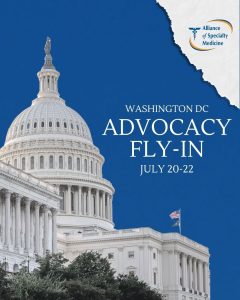 The Alliance of Specialty Medicine held its annual Legislative Advocacy Conference in Washington, DC, in July, bringing together nearly one hundred specialists from across the country to advocate for greater access to specialty care.
Reforms to the Medicare Physician Fee Schedule were the main focus of this year’s conference, as Members and staff of the House GOP and Democratic Doc Caucuses discussed proposals to reform and stabilize the Medicare payment system. They also heard presentations on reforming prior authorization and step therapy, and heard a scientist’s perspective on the potential implications of the Office of Management and Budget’s proposal to dramatically alter and politicize the federal grantmaking process.
The Alliance also heard from regulators, as senior officials from Health and Human Services (HHS) and the Centers for Medicare and Medicaid Services (CMS) offered their perspectives on America’s healthcare ecosystem and what to expect from the Trump Administration in the future.
The Alliance physicians then went to Capitol Hill to bring the message home and urge support for Medicare physician payment reform, as well as prior authorization and step therapy reforms.
The Alliance will continue to advocate for these issues as Congress wraps up its session at the end of the year. Issue briefs on all these issues are available on the Alliance website.
Rheumatologists Call for Broader Drug Affordability Solutions for Patients in Response to Wyden RFI
 In August, the Coalition for State Rheumatology Organizations (CSRO) submitted comments to Senate Finance Committee Ranking Member Ron Wyden in response to his Request for Information (RFI), Commonsense Policy Options to Lower Drug Prices for Patients, which builds on the Senate Democratic Caucus’s work on drug affordability since the enactment of the Inflation Reduction Act. CSRO urged lawmakers to evaluate affordability holistically, weighing whether the root cause lies in drug price or other factors such as benefit design or failure to pass rebates through to patients.
In its comments, CSRO warned that the Most Favored Nation (MFN) model would restrict patients’ access to essential medications while threatening the viability of private practices, since rheumatology’s “buy and bill” model cannot absorb the proposed reimbursement cuts. CSRO also urged lawmakers to consider the bigger picture on biosimilar development and adoption, noting that uptake has been slower than expected due to “underwater” reimbursement for many physician-administered biosimilars. To address this, CSRO proposed that lawmakers work with CMS to reform step therapy policies and establish a formulary adequacy standard, so patients can access an alternative therapy when a given biosimilar is underwater. CSRO also encouraged Congress to ban copay accumulator adjustment programs and to tackle vertical integration by the largest pharmacy benefit managers (PBMs) and their healthcare parent companies as additional legislative solutions to address drug affordability for patients.
Alliance Voices Strong Concerns over
OMB Federal Financial Assistance Rule
The Alliance of Specialty Medicine submitted a comment letter to the Office of Management and Budget (OMB) requesting that OMB withdraw a proposed regulation  that would significantly tighten the parameters around the allocation and use of federal funds and grants. The Alliance believes that, if finalized, this regulation would undermine the integrity of federally funded medical research by introducing political influence into grant-making and scientific oversight. In addition to concerns about provisions that would weaken peer review while granting political appointees greater authority over funding decisions, the Alliance raised concerns about proposals to expand the government’s grant-termination powers and to restrict the use of federal funds for international collaboration, professional society membership, conference participation, and publications. Overall, these new requirements could disrupt long-term research, hinder scientific collaboration, and reduce the dissemination of medical discoveries. The Alliance calls on OMB to work with the research community to improve transparency and accountability while preserving merit-based funding, scientific independence, and the advancement of patient care. The Alliance joined over 292,000 stakeholders in submitting comments on this proposal.
Congress recently passed a stopgap measure to fund the federal government through December 11th. This Continuing Resolution (CR) includes a key provision that temporarily blocks the Office of Management and Budget (OMB) from finalizing or implementing its proposed overhaul of federal grant rules for the duration of the CR.